
Amer Shalaby
Professor
Department of Civil & Mineral Engineering
Email: amer.shalaby@utoronto.ca
Office: SF3001H
Tel: 416-978-5054
Expertise:
Areas of Specialization:
Public Transportation Operations and Planning
Background
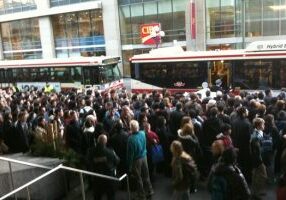
Professor Amer Shalaby focuses his research on crowds and congestion, both at the local and global levels, with particular emphasis on disruption management. This work intends to help transportation authorities to respond more effectively to unexpected impediments or crises within a network, and permit the rerouting of passengers without seriously affecting migration patterns. As this work continues to evolve it will have ramifications for predicting crowd behaviours on micro levels, such as subways and other public transit applications, where large crowd congestions occur.
Research Interests
Public Transportation
Intelligent Transportation Systems with emphasis on advanced public transit systems
Transportation planning of large-scale events and mega cities
Simulation and modelling of transportation systems
Education
BSc., 1988 Department of Civil Engineering, Ain Shams University, Egypt
MASc, 1991 Department of Civil Engineering, University of Toronto
Thesis Title: Effect of With-Flow Bus Lanes on Bus Performance
Supervisor: Professor Richard Soberman
PhD, 1996 Department of Civil Engineering, University of Toronto
Thesis Title: Investigating Mode Split for the Work Trip: Role of Relative Level of Service and Interaction with Mobility Dimensions
Supervisor: Professor Gerald Steuart
- Bahen/Tanenbaum Chair in Civil Engineering, U of T
- Co-Director - Centre for Automated and Transformative Transportation Systems (CATTS)
- Head - Transit Analytics Lab
- Affiliate - U of T Mobility Network
- Affiliate - U of T Data Sciences Institute Network (DSI)
- Affiliate - U of T School of Cities
- International Associate - Public Transport Research Group (Australia)
- Fellow Canadian Society of Civil Engineering
- Associate Editor - Canadian Journal of Civil Engineering
Publications
- Lee-Gosselin, M., S. Doherty, and A. Shalaby, 2010. "Personal Data Collection using Mobile ICTs", in “Movement-Aware Applications for Sustainable Mobility: Technologies and Approaches”, pp. 1-14, Monica Wachowicz (Editor), IGI Global.
- Wahba, M. and A. Shalaby, 2009. “MILATRAS: A New Modelling Framework for the Transit Assignment Problem”, in “Schedule-Based Modeling of Transportation Networks: Theory and Applications”, Chapter 9, pp. 171-194, Nigel Wilson and Agostino Nuzzolo (Eds.), Springer-Verlag (ISBN: 978-0-387-84812-9).
- Wahba, M. and A. Shalaby, 2006. “A General Multi-Agent Modelling Framework for the Transit Assignment Problem: A Learning-Based Approach”, Lecture Notes in Computer Science, Vol. 3473, Chapter 26, pp. 276-295, T. Böhme et al. (Eds.), Springer-Verlag Berlin Heidelberg.
- Auda, G., T. Rabie, A. El-Rabbany, A. Shalaby, and B. Abdulhai, 2004. “An Active-Vision Intelligent Traffic Monitoring System”, in Recent Research Developments in Pattern Recognition, Vol. 4, Chapter 1, pp. 1-13, Transworld Research Network (ISBN: 81-7895-157-6).
- Alshalalfah, B., A. Shalaby, S. Dale and F. Othman, 2011. “Aerial Ropeway Transportation Systems in the Urban Environment: State of the Art”, forthcoming, ASCE Journal of Transportation Engineering.
- Currie, G. and A. Shalaby, 2011. “Synthesis of Transport Planning Approaches for the World’s Largest Events”, forthcoming, Journal of Transport Reviews.
- Wahba M. and A. Shalaby, 2011. “Large-Scale Application of MILATRAS: Case Study of the Toronto Transit Network”, Transportation, DOI 10.1007/s11116-011-9358-5.
- Alshalalfah, B. and A. Shalaby, 2011. “Feasibility of Flex-Route as a Feeder Transit Service to Rail Stations in the Suburbs: Case Study in Toronto”, forthcoming, ASCE Journal of Urban Planning and Development.
- Roorda, M., A. Shalaby and S. Saneinejad, 2011. “Comprehensive Transportation Data Collection: Case Study in the Greater Golden Horseshoe, Canada”, ASCE Journal of Urban Planning and Development, 137(2):193-203.
- Alshalalfah, B. and A. Shalaby, 2011. “A new Algorithm for Scheduling Flex-Route Transit Services in a Constraint Programming Environment”, forthcoming, Public Transport: Operations and Planning.
- Lo, L., A. Shalaby and B. Alshalalfah, 2011. “Case Study: Relationship between Immigrant Settlement Patterns and Transit Use in the Greater Toronto Area”, forthcoming, ASCE Journal of Urban Planning and Development.
- Byon, Y., B. Abdulhai and A. Shalaby, 2010. “Incorporating Scenic View, Slope and Crime Rates into Route Choices: Emphasis on 3-D GIS with Digital Elevation Models and Crime Rate Geospatial Data”, Transportation Research Record, 2183: 94-102.
- Hadayeghi, A., A. Shalaby, and B. Persaud, 2010. “Development of Planning Level Transportation Safety Models using Full Bayesian Semiparametric Additive Techniques”, Journal of Transportation Safety and Security, 2(1):45-68.
- Hadayeghi A., A. Shalaby and B. Persaud, 2010. “Development of Planning Level Transportation Safety Tools using Geographically Weighted Poisson Regression”, Journal of Accident Analysis and Prevention, 42(2):676-688.
- Byon, Y., B. Abdulhai and A. Shalaby, 2009. “Real-Time Transportation Mode Detection via Tracking GPS Mobile Devices”, Journal of Intelligent Transportation Systems, 13(4):161-170.
- Shahla F., A. Shalaby, B. Persaud and A. Hadayeghi, 2009. “Analysis of Transit Safety at Signalized Intersections”, Transportation Research Record, 2102:108-114.
- Crowley D., A. Shalaby, and H. Zarei, 2009. “Access Walking Distance, Transit Use and the Success of Transit Oriented Development in North York City Centre”, Transportation Research Record, 2110:96-105.
- Cheung, C., A. Shalaby, B. Persaud and A. Hadayeghi, 2008. “Models for Safety Analysis of Road Surface Transit”, Transportation Research Record, 2063:168-175.
- Currie, G. and A. Shalaby, 2008. “Active Transit Signal Priority for Streetcars –Experience in Melbourne, Australia and Toronto, Canada”, Transportation Research Record, 2042:41-49.
- Chung, E. and A. Shalaby, 2007. “Expected Time of Arrival Model for School Bus Transit Using Real-Time GPS-Based AVL Data”, Journal of Intelligent Transportation Systems, 11(4):157-167.
- Chung, E. and A. Shalaby, 2007. “Development of a Control Strategy for Intermodal Connection Protection of Timed-Transfer Transit Routes”, Transportation Research Record, 2006:3-10.
- Hadayeghi, A., A. Shalaby and B. Persaud, 2007. “Safety Prediction Models: A Proactive Tool for Safety Evaluation in Urban Transportation Planning Applications”, Transportation Research Record, 2019:225-236.
- Currie, G. and A. Shalaby, 2007. “Success and Challenges in Modernising Streetcar Systems –Experience in Melbourne and Toronto”, Transportation Research Record, 2006:31-39.
- Alshalalfah, B. and A. Shalaby, 2007. “Relationship of Walk Access Distance to Transit with Service, Travel and Personal Characteristics”, ASCE Journal of Urban Planning and Development, 133(2):114-118.
- Parveen, M., A. Shalaby and M. Wahba, 2007. “G-EMME/2: An Automatic Calibration Tool of the EMME/2 Transit Assignment using Genetic Algorithms”, ASCE Journal of Transportation Engineering, 133(10):549-598.
- Shalaby, A., K. Ling and J. Sinikas, 2007. “Evaluation of Multiple-Unit Streetcar Operation in Toronto, Canada”, Transportation Research Circular, 112:579-594.
- Shalaby, A., J. Lee, J. Greenough, S. Hung and M. Bowie, 2006. “Development, Evaluation, and Selection of Advanced Transit Signal Priority Concept Directions”, Journal of Public Transportation, 9(5):97-120.
- Chowdhury, S., I. Kaysi, and A. Shalaby, 2006. “Optimal Bid Packaging Algorithm for Competitive Contracting of Public Transit”, Transportation Research Record, 1986:46-53.
- Tsui, A. and A. Shalaby, 2006. “An Enhanced System for Link and Mode Identification for GPS-based Personal Travel Surveys”, Transportation Research Record, 1972:38-45.
- Mohammed, A., A. Shalaby, and E. Miller, 2006. “An Empirical Analysis of Transit Network Evolution: Case Study of the Mississauga, Ontario Bus Network”, Transportation Research Record, 1971:51-58.
- Hadayeghi, A., A. Shalaby, B. Persaud, and C. Cheung, 2006. “Temporal Transferability and Updating of Zonal Level Accident Prediction Models”, Journal of Accident Analysis and Prevention, 38(3):579-589.
- Chung, E., and A. Shalaby, 2005. “A Trip Reconstruction Tool for GPS-Based Personal Travel Surveys”, Journal of Transportation Planning and Technology, 28(5):381-401.
- Kennedy, C., E. Miller, A. Shalaby, H. MacLean and J. Coleman, 2005. “The Four Pillars of Sustainable Urban Transportation”, Journal of Transport Reviews, 25(4):393-414.
- Lee, J., A. Shalaby, J. Greenough, M. Bowie and S. Hung, 2005. “Advanced Transit Signal Priority Control Using On-line Microsimulation-based Transit Prediction Model”, Transportation Research Record, 1925:185-194.
- Tsang, F., A. Shalaby and E. Miller, 2005. “Improved Park-and-Ride Modelling: Capturing the Within-day Dynamics”, Journal of Advanced Transportation, 39(2):117-137.
- Wahba, M. and A. Shalaby, 2005. “A Multi-Agent Learning-Based Approach to the Transit Assignment Problem: A Prototype”, Transportation Research Record, 1926:96-105.
- Lee, J., B. Abdulhai, A. Shalaby and E. Chung, 2005. “Real-Time Optimization for Adaptive Traffic Signal Control using Genetic Algorithms”, Journal of Intelligent Transportation Systems, 9(3):111-122.
- Ling, K., and A. Shalaby, 2005. “A Reinforcement Learning Approach to Streetcar Bunching Control”, Special Issue on Applications of New Technologies for Transit System Operations and Management, Journal of Intelligent Transportation Systems, 9(2):59-68.
- Rabie, T., B. Abdulhai, A. Shalaby and A. El-Rabbany, 2005. “Mobile Active-Vision Traffic Surveillance in Urban Networks”, Special Issue on Computing and Information Technologies in Transportation Systems, International Journal of Computer-Aided Civil and Infrastructure Engineering, 20(4):231-241.
- Ling, K. and A. Shalaby, 2004. “Automated Transit Headway Control via Adaptive Signal Priority”, Special Issue on Modelling for Transit Operations and Service Planning, Journal of Advanced Transportation, 38(1):45-67.
- Shalaby, A. and A. Farhan, 2004. “Prediction Model of Bus Arrival and Departure Times Using AVL and APC Data”, Journal of Public Transportation, 7(1):41-61.
- Hadayeghi, A., A. Shalaby and B. Persaud, 2003. “Macrolevel Accident Prediction Models for Evaluating Safety of Urban Transportation Systems”, Transportation Research Record, 1840:87-95.
- Shalaby, A., B. Abdulhai and J. Lee, 2003. “Assessment of Streetcar Transit Priority Options Using Microsimulation Modelling”, Special Issue on Innovations in Transportation Engineering, Canadian Journal of Civil Engineering, 30(6):1000-1009.
- Miller, E. and A. Shalaby, 2003. “Evolution of Person Travel in the Toronto Area & Policy Implications”, ASCE Journal of Urban Planning and Development, 129(1):1-26.
- Shalaby, A., 2002. “A Simplified Approach for the Historical Analysis of Urban Person Travel”, Canadian Journal of Civil Engineering, 29(5):702-712.
- Bracewell, D., T. Sayed and A. Shalaby, 1999. “High Occupancy Vehicle Monitoring and Evaluation Framework”, Transportation Research Record, 1682:38-45.
- Shalaby, A., 1999. “Simulating Performance Impacts of Bus Lanes and Supporting Measures”, ASCE Journal of Transportation Engineering, 125(5):390-397.
- Shalaby, A., 1998. “Investigating the Role of Relative Level-of-Service Characteristics in Explaining Mode Split for the Work Trip”, Journal of Transportation Planning and Technology, 22(2):125-148.
- Shalaby, A. and G. Steuart, 1996. “Trip End Mode Split”, Transportation Research Record, 1556:58-66.
- Shalaby, A., and R. Soberman, 1994. “Effect of With-Flow Bus Lanes on Bus Travel Times”, Transportation Research Record, 1433:24-30.
- Osman, A., K. Habib, A. Tudela and A. Shalaby. “Investigating the Effects of Psychological Factors on Commuting Mode Choice Behaviour”, Transportation Research – Part F.
- Mohammed, A., A. Shalaby and E. Miller. “P-TRANE: Modeling Bus Transit Network Evolution in a GIS-Based Framework”, Transportation Research Record.
- Huang, S., A. Shalaby and R. Bissessar, January 2012. “Impacts of Transit Priority on Signal Coordination: Case Study of Toronto”, Transportation Research Record.
- Hunter, A., S. Steiniger, B. Sandalack, S. Liang, L. Kattan, A. Shalaby, F. Uribe, C. Bliss-Taylor and R. Martinson. “PlanYourPlace: a geospatial infrastructure for sustainable community planning”, International Journal of Geomatics and Spatial Analysis.
- Forsey, D., K. Habib, E. Miller and A. Shalaby. “An Analysis of the Impact of a New Bus Transit System on the Transferability of Work Trip Mode Choice Models”, Transportmetrica.
- Osman, A., A. Shalaby and K. Habib. “Towards a Learning-based Mode Shift Model: A Conceptual Framework”, Transportation Letters.
- Alshalalfah, B., A. Shalaby, S. Dale and F. Othman. “Experiences with Aerial Ropeway Transportation Systems in the Urban Environment”, Transportation Research - Part A.
- Alshalalfah, B., A. Shalaby, S. Dale and F. Othman. “Aerial Ropeway Transit: Review of Available Technologies”, Transportmetrica.
- Byon, Y., A. Shalaby and B. Abdulhai. “Traffic Data Fusion using SCAAT Kalman Filters: Emphasis on Sampling Strategies with GPS Probes, Loop Detectors and Other Information Sources”, IEEE Transactions on Intelligent Transportation Systems.
- Dumont, J, A. Shalaby and M. Roorda. “GPS-Aided Survey for Assessing Trip Reporting Accuracy and Travel of Students without Land Lines”, Journal of Transportation Planning and Technology.
- Chung, Eui-Hwan and A. Shalaby. “Development of a Holding Control Model for Real-Time Connection Protection - the case of two delayed feeder trips”, Public Transport: Operations and Planning.
- Chung, Eui-Hwan and A. Shalaby. “Real-Time Holding Control Model for Connection Protection of Timed-Transfer Transit Routes”, Journal of Intelligent Transportation Systems.
- Chung, Eui-Hwan and A. Shalaby. “Transfer Optimization Model for Intermodal Transit Services into the Suburbs”, Journal of Transportation Research, Part A.
- Wahba M. and A. Shalaby. “A Learning-based Framework for Modelling Passenger's Behaviour with Information Provision”, Transportation.
- Lee, J. and A. Shalaby. “Adaptive Transit Signal Priority Control based on a Real-Time Transit Travel Time Prediction Model”, Canadian Journal of Civil Engineering.
- Lai, L. and A. Shalaby. “Cellular Automaton Simulation of Vehicle Dynamics in Park-and-Ride Facilities”, Canadian Journal of Civil Engineering.
- Li, Z. and A. Shalaby. “Web-based GIS System for Prompted Recall of GPS-assisted Personal Travel Surveys: System Development and Experimental Study”.
- Abdelgawad, H., A. Shalaby, B. Abdulhai and A. Gutub, January 2012. “Microscopic Modeling of Large-Scale Pedestrian-Vehicle Conflicts in the City of Madinah, Saudi Arabia”, submitted, 91st Annual Transportation Research Board Meeting, Washington D.C.
- Osman, A., K. Habib, A. Tudela and A. Shalaby. “Investigating the Effects of Psychological Factors on Commuting Mode Choice Behaviour”, 91st Annual Transportation Research Board Meeting, Washington D.C.
- Mohammed, A., A. Shalaby and E. Miller, January 2012. “P-TRANE: Modeling Bus Transit Network Evolution in a GIS-Based Framework”, 91st Annual Transportation Research Board Meeting, Washington D.C.
- Forsey, D., K. Habib, E. Miller and A. Shalaby, January 2012. “An Evaluation of the Ridership Impacts of the VIVA Bus Transit System”, 91st Annual Transportation Research Board Meeting, Washington D.C.
- Srikukenthiran, S. and A. Shalaby, July 2011. “Scalable Microsimulation Modelling Framework of Crowd and Subway Network Dynamics for Improved Disruption Management”, Computers in Urban Planning and Urban Management 2011 Conference, Lake Louise, Alberta.
- Osman, A., K. Habib, A. Tudela and A. Shalaby, July 2011. “Identifying Effects of Psychological Factors Measured in Semantic Scales on Mode Choice Behaviour using a Multivariate Statistical Model”, Computers in Urban Planning and Urban Management 2011 Conference, Lake Louise, Alberta.
- Alshalalfah, B. and A. Shalaby, January 2011. “Aerial Ropeway Transit: State of the ART”, CD Proceedings of the 90th Annual Transportation Research Board Meeting, Washington D.C.
- Roorda, M., A. Shalaby and S. Saneinejad, July 2010. “Transportation Data Collection for the Future: A Case Study in the Greater Golden Horseshoe, Canada”, the 2010 World Conference on Transportation Research, Lisbon, Portugal.
- Osman, A. and A. Shalaby, June 2010. “A Modal Shift Optimized Transit Route Design Model”, CD Proceedings of the 2nd Annual TRANSLOG 2010 Conference in Transportation and Logistics, Hamilton, Canada.
- Alshalalfah, B. and A. Shalaby, January 2010. “Development of Important Relationships for the Planning of Flex-Route Transit Services”, CD Proceedings of the 89thAnnual Transportation Research Board Meeting, Washington D.C.
- Hadayeghi A., A. Shalaby and B. Persaud, January 2010. “Development of Planning Level Transportation Safety Models using Full Bayesian Semiparametric Additive Techniques”, CD Proceedings of the 89th Annual Transportation Research Board Meeting, Washington D.C.
- Shalaby, A., K. Woo and G. Currie, January 2010. “Exploring Transit Ridership Drivers in Toronto and Melbourne”, CD Proceedings of the 89th Annual Transportation Research Board Meeting, Washington D.C.
- Byon, Y., A. Shalaby, B. Abdulhai and S. Elshafiey, January 2010. “Traffic Data Fusion using SCAAT Kalman Filters”, CD Proceedings of the 89th Annual Transportation Research Board Meeting, Washington D.C.
- Byon, Y., B. Abdulhai and A. Shalaby, January 2010. “Incorporating Scenic View, Slope and Crime Rates into Route Choices: Emphasis on 3-D GIS with Digital Elevation Models and Crime Rates Geospatial Data”, CD Proceedings of the 89th Annual Transportation Research Board Meeting, Washington D.C.
- Lo, L., A. Shalaby and B. Alshalalfah, January 2010. “Immigrant Settlement and Transit Use in Canada: Patterns and Policy Implications”, CD Proceedings of the 89th Annual Transportation Research Board Meeting, Washington D.C.
- Chung, E. and A. Shalaby, July 2009. “Development of a Holding Control Model for Real-Time Connection Protection”, CD Proceedings of the 11th Conference on Advanced Systems for Public Transport, Hong Kong.
- Alshalalfah, B. and A. Shalaby, July 2009. “A new Algorithm for Scheduling Flex-Route Transit Services in a Constraint Programming Environment”, CD Proceedings of the 11th Conference on Advanced Systems for Public Transport, Hong Kong.
- Wong, A., A. Shalaby, and B. Abdulhai, July 2009. “Arrival Time Prediction Model for Regional Bus Transit”, CD Proceedings of the 11th Conference on Advanced Systems for Public Transport, Hong Kong.
- Crowley D., A. Shalaby, and H. Zarei, January 2009. “Access Walking Distance, Transit Use and the Success of Transit Oriented Development in North York City Centre”, CD Proceedings of the 88th Annual Transportation Research Board Meeting, Washington D.C.
- Chung E. and A. Shalaby, January 2009. “Holding Control Model for Real-Time Connection Protection”, CD Proceedings of the 88th Annual Transportation Research Board Meeting, Washington D.C.
- Alshalalfah B. and A. Shalaby, January 2009. “Feasibility and Performance of Flex-Route Transit Service in Suburban Areas”, CD Proceedings of the 88th Annual Transportation Research Board Meeting, Washington D.C.
- Shahla F., A. Shalaby, B. Persaud and A. Hadayeghi, January 2009. “Analysis of Transit Safety at Signalized Intersections”, CD Proceedings of the 88th Annual Transportation Research Board Meeting, Washington D.C.
- Wahba M. and A. Shalaby, January 2009. “Learning-based Departure Time and Path Choice Modelling for Transit Assignment under Information Provision: A Theoretical Framework”, CD Proceedings of the 88th Annual Transportation Research Board Meeting, Washington D.C.
- Wahba M. and A. Shalaby, January 2009. “Large-Scale Application of MILATRAS: Case Study of the Toronto Transit Network”, CD Proceedings of the 88th Annual Transportation Research Board Meeting, Washington D.C.
- Hadayeghi A., A. Shalaby and B. Persaud, January 2009. “Development of Planning Level Transportation Safety Tools Using Geographically Weighted Poisson Regression”, CD Proceedings of the 88th Annual Transportation Research Board Meeting, Washington D.C.
- Lee, J., A. Shalaby and B. Abdulhai, November 2008. “Optimized Strategy for Integrated Traffic and Transit Signal Control”, 4th International Gulf Conference on Roads (IGCR), Doha, Qatar.
- Shih, A. and A. Shalaby, November 2008. “Travel Mode Split in the Greater Toronto Area: Long-Range Temporal Trends and Underlying Travel Behaviour”, 4th International Gulf Conference on Roads (IGCR), Doha, Qatar.
- Hadayeghi A., A. Shalaby and B. Persaud, June 2008. “Development of Planning Level Transportation Safety Tools Using Geographically Weighted Poisson Regression”, Canadian Multidisciplinary Road Safety Conference, Whistler, British Columbia.
- Chung, E. and A. Shalaby, January 2008. “Transfer Optimization Model for Inter-Modal Transit Services into the Suburbs”, CD Proceedings of the 87th Annual Transportation Research Board Meeting, Washington D.C.
- Li, Z. and A. Shalaby, January 2008. “Web-based GIS System for Prompted Recall of GPS-assisted Personal Travel Surveys: System Development and Experimental Study”, CD Proceedings of the 87th Annual Transportation Research Board Meeting, Washington D.C.
- Cheung, C., A. Shalaby, B. Persaud and A. Hadayeghi, January 2008. “Models for Safety Analysis of Road Surface Transit”, CD Proceedings of the 87th Annual Transportation Research Board Meeting, Washington D.C.
- Alshalalfah, B. and A. Shalaby, January 2008. “Sensitivity of Flex-Route Transit Service to Design and Schedule-Building Characteristics”, CD Proceedings of the 87th Annual Transportation Research Board Meeting, Washington D.C.
- Currie, G. and A. Shalaby, January 2008. “Active Transit Signal Priority for Streetcars –Experience in Melbourne and Toronto”, CD Proceedings of the 87th Annual Transportation Research Board Meeting, Washington D.C.
- Mohammed, A., A. Shalaby and E. Miller, June 2007. “PREMOTRANE - Modelling the Transit Network Evolution”, CD Proceedings of the 11th World Conference on Transportation Research, Berkeley, CA, USA.
- Hadayeghi, A., A. Shalaby and B. Persaud, June 2007. “A Proactive Tool for Safety Evaluation in Urban Transportation Planning Applications”, CD Proceedings of the Canadian Multidisciplinary Road Safety Conference, Montréal, Québec.
- Wahba, M. and A. Shalaby, January 2007. “A Microsimulation Model for Transit Assignment with Information Provision - Results from a MILATRAS Prototype”, CD Proceedings of the 86th Annual Transportation Research Board Meeting, Washington D.C.
- Chung, E. and A. Shalaby, January 2007. “Development of a Control Strategy for Intermodal Connection Protection of Timed-Transfer Transit Routes”, CD Proceedings of the 86thAnnual Transportation Research Board Meeting, Washington D.C.
- Chung, E. and A. Shalaby, January 2007. “Expected Time of Arrival Model for School Bus Transit Using Real-Time GPS-Based AVL Data”, CD Proceedings of the 86th Annual Transportation Research Board Meeting, Washington D.C.
- Shalaby, A., A. Georgi, K. Ling, J. Sinikas and A. Salzberg, January 2007. “Evaluation of Proof-of-Payment and Multiple-Unit Operation in Different Streetcar Route Configurations”, CD Proceedings of the 86th Annual Transportation Research Board Meeting, Washington D.C.
- Hadayeghi, A., A. Shalaby and B. Persaud, January 2007. “Safety Prediction Models: A Proactive Tool for Safety Evaluation in Urban Transportation Planning Applications”, CD Proceedings of the 86th Annual Transportation Research Board Meeting, Washington D.C.
- Byon, Y., B. Abdulhai and A. Shalaby, January 2007. “Determination of Sampling Rate of GPS-enabled Cell Phone for Mode Detection and GIS Map Matching Algorithm”, CD Proceedings of the 86th Annual Transportation Research Board Meeting, Washington D.C.
- Lai, L. and A. Shalaby, January 2007. “Cellular Automaton Simulation of Vehicle Dynamics in Park-and-Ride Facilities”, CD Proceedings of the 86th Annual Transportation Research Board Meeting, Washington D.C.
- Currie, G. and A. Shalaby, January 2007. “Success and Challenges in Modernising Streetcar Systems –Experience in Melbourne and Toronto”, CD Proceedings of the 86th Annual Transportation Research Board Meeting, Washington D.C.
- Lee-Gosselin, M., S. Doherty, and A. Shalaby, November 2006. "Personal Data Collection using Mobile ICTs ", CD Proceedings of the Second International Specialist Meeting on ICT, Bergen, The Netherlands.
- Wahba, M. and A. Shalaby, September 2006. “MILATRAS: A Microsimulation Platform for Testing Transit-ITS Policies and Technologies”, IEEE ITSC 2006, Toronto, Canada.
- Byon, Y., A. Shalaby and B. Abdulhai, September 2006. “Travel Time Collection and Traffic Monitoring Via GPS Technologies”, IEEE ITSC 2006, Toronto, Canada.
- Lee, J., A. Shalaby, J. Greenough, S. Hung and M. Bowie, January 2006. “TSP-Advance: An Advanced Transit Signal Priority System - Development and Evaluation”, CD Proceedings of the 85th Annual Transportation Research Board Meeting, Washington D.C.
- Hadayeghi, A., A. Shalaby, B. Persaud and C. Cheung, January 2006. “Temporal Transferability and Updating of Safety Planning Models”, CD Proceedings of the 85th Annual Transportation Research Board Meeting, Washington D.C.
- Shalaby, A., K. Ling and J. Sinikas, January 2006. “Multiple-Unit Streetcar Operation: Evaluation using Miscrosimulation Modelling”, CD Proceedings of the 85thAnnual Transportation Research Board Meeting, Washington D.C.
- Tsui, A. and A. Shalaby, January 2006. “An Enhanced System for Link and Mode Identification for GPS-based Personal Travel Surveys”, CD Proceedings of the 85th Annual Transportation Research Board Meeting, Washington D.C.
- Chowdhury, S., I. Kaysi, and A. Shalaby, January 2006. “Optimal Bid Packaging Algorithm for Competitive Contracting of Public Transit”, CD Proceedings of the 85thAnnual Transportation Research Board Meeting, Washington D.C.
- Mohammed, A., A. Shalaby, and E. Miller, January 2006. “An Empirical Analysis of Transit Network Evolution: Case Study of the Mississauga, Ontario Bus Network”, CD Proceedings of the 85th Annual Transportation Research Board Meeting, Washington D.C.
- Byon, Y., A. Shalaby, and B. Abdulhai, January 2006. “GISTT: GPS-GIS Integrated System for Travel Time Surveys”, CD Proceedings of the 85th Annual Transportation Research Board Meeting, Washington D.C.
- Miller, E., B. Abdulhai and A. Shalaby, June 2005. “Towards Sustainable Urban Transportation”, CD Proceedings of the 33rd CSCE Annual Conference (6thTransportation Specialty Conference), Toronto.
- Tsang, F. and A. Shalaby, June 2005. “Comparison of Travel Characteristics between Emerging Suburban Activity Centres and Downtown Toronto”, CD Proceedings of the 33rdCSCE Annual Conference (6th Transportation Specialty Conference), Toronto.
- Shalaby, A. and M. Wahba, May 2005. “MIcrosimulation Learning-based Approach for TRansit ASsignment (MILATRAS): Methodology”, Second Workshop on the Schedule-Based Approach in Dynamic Transit Modelling: Theory and Applications, Ischia, Italy, p.125-130.
- Wahba, M. and A. Shalaby, May 2005. “MIcrosimulation Learning-based Approach for TRansit ASsignment (MILATRAS): Operational Prototype”, Second Workshop on the Schedule-Based Approach in Dynamic Transit Modelling: Theory and Applications, Ischia, p. 131-137, Italy.
- Wahba, M. and A. Shalaby, January 2005. “A Multi-Agent Learning-Based Approach to the Transit Assignment Problem: A Prototype”, CD proceedings of the 84th Annual Transportation Research Board Meeting, Washington D.C.
- Alshalalfah, B. and A. Shalaby, January 2005. “Relationship between Walk Access Distance to Transit and Socioeconomic, Demographic and Transit Service Characteristics”, CD proceedings of the 84th Annual Transportation Research Board Meeting, Washington D.C.
- Hadayeghi, A., A. Shalaby, and B. Persaud, January 2005. “Investigation of the Temporal Transferability of Zonal Level Accident Prediction Models”, CD proceedings of the 84th Annual Transportation Research Board Meeting, Washington D.C.
- Lee, J., A. Shalaby, J. Greenough, M. Bowie and S. Hung, January 2005. “Advanced Transit Signal Priority Control Using On-line Microsimulation-based Transit Prediction Model”, CD proceedings of the 84th Annual Transportation Research Board Meeting, Washington D.C.
- Shalaby, A. and K. Ling, July 2004. “Bunch Breaker: A Reinforcement Learning Multi-Agent for Transit Operations Control”, CD Proceedings of the 10th World Conference on Transport Research, Istanbul, Turkey.
- Ling, K., and A. Shalaby, January 2004. “Multiple Reinforcement-Learning Agents for Transit Vehicle Bunching Control”, CD proceedings of the 83rd Annual Transportation Research Board Meeting, Washington D.C.
- Lee, J., E. Chung, B. Abdulhai and A. Shalaby, January 2004. “Real-Time Optimization for Adaptive Traffic Signal Control using Genetic Algorithms”, CD proceedings of the 83rd Annual Transportation Research Board Meeting, Washington D.C.
- Tsang, F., A. Shalaby and E. Miller, January 2004. “Improved Park-and-Ride Modelling: Capturing the Within-day Dynamics”, CD proceedings of the 83rd Annual Transportation Research Board Meeting, Washington D.C.
- Chung, E., and A. Shalaby, January 2004. “Development of a Trip Reconstruction Tool for GPS-Based Personal Travel Surveys”, CD proceedings of the 83rd Annual Transportation Research Board Meeting, Washington D.C.
- Shalaby, A. and A. Farhan, January 2003. “Bus Travel Time Prediction Models For Dynamic Operations Control and Passenger Information Systems”, CD proceedings of the 82ndAnnual Transportation Research Board Meeting, Washington D.C.
- Hadayeghi, A., A. Shalaby and B. Persaud, January 2003. “Accident Prediction Models for Safety Evaluation of Urban Transportation Networks”, CD proceedings of the 82ndAnnual Transportation Research Board Meeting, Washington D.C.
- Ling, K. and A. Shalaby, December 2002. “Reinforcement Learning Algorithm for Transit Headway Control at Traffic Signals”, ASI Workshop on Advanced Modeling for Transit Operations and Service Planning, Hong Kong, pp. D3-1 to D3-11.
- Shalaby, A. and A. Farhan, September 2002. “An Integrated Modeling System for Dynamic Operations Control and Real-Time Transit Information”, CD Proceedings of the IEEE 5th International Conference on Intelligent Transportation Systems, Singapore.
- Rabie, T., A. Shalaby, B. Abdulhai and A. El-Rabbany, September 2002. “Mobile Vision-Based Vehicle Tracking and Traffic Control”, Proceedings of the IEEE 5th International Conference on Intelligent Transportation Systems, Singapore, pp. 13-18.
- Lee, J., B. Abdulhai, A. Shalaby and A. Georgi, August 2002. “Modelling of Streetcar Transit Priority Options”, CD Proceedings of the ASCE 7th International Conference on Applications of Advanced Technology in Transportation, Cambridge, Massachusetts.
- Farhan, A., A. Shalaby and T. Sayed, August 2002. “Bus Travel Time Prediction Using GPS and APC”, CD Proceedings of the ASCE 7th International Conference on Applications of Advanced Technology in Transportation, Cambridge, Massachusetts.
- Rabie, T., G. Auda, A. El-Rabbany, A. Shalaby and B. Abdulhai, June 2002. “Active-Vision-Based Traffic Surveillance and Control”, CD Proceedings of the 14thInternational Conference on Vision Interface, Ottawa, Canada.
- Shalaby, A., April 2002. “Socioeconomic, Land Use and Travel Characteristics of the Toronto Area”, Proceedings of the ASCE Second International Conference on Urban Public Transportation Systems, Virginia. pp. 356-368.
- Mohammed, B., A. Shalaby and B. Abdulhai, January 2002. “Development of HOV Lane Treatment Plan for Highway 401 in Toronto Using Microsimulation”, CD proceedings of the 81st Annual Transportation Research Board Meeting, Washington D.C.
- Abdulhai, B., A. Shalaby, J. Lee and A. Georgi, January 2002. “Microsimulation Modeling and Impact Assessment of Streetcar Transit Priority Options: The Toronto Experience”, CD proceedings of the 81st Annual Transportation Research Board Meeting, Washington D.C.
- Shalaby, A., C. Lyon and T. Sayed, August 2001. "Transferability of Travel Time Models and Provision of Real-Time Arrival Time Information", CD Proceedings of the IEEE 4th International Conference on Intelligent Transportation Systems, Oakland, California.
- Miller, E. and A. Shalaby, January 2001. “Historical Trends in Travel Behaviour in the Greater Toronto Area and Policy Implications,” CD proceedings of the 80th Annual Transportation Research Board Meeting, Washington D.C.
- Rabie, T., G. Auda, A. El-Rabbany, A. Shalaby and B. Abdulhai, January 2001. “An Innovative Active-Vision-Based Approach for Traffic Surveillance and Control”, CD Proceedings of the 3rd International Symposium on Mobile Mapping Technology, Cairo.
- Shalaby, A., June 2000. “An Approach to Assess Relative Contributions of Urban Changes to Travel Growth”, CD Proceedings of the 3rd Transportation Specialty Conference, Canadian Society of Civil Engineering, London, Ontario.
- Miller, E. and A. Shalaby, June 2000. “Travel Behaviour in the Greater Toronto Area and Policy Implications”, CD Proceedings of the 3rd Transportation Specialty Conference, Canadian Society of Civil Engineering, London, Ontario.
- Shalaby, A., G. Steuart, N. Irwin and L. Sims, June 1998. “Changes in Travel-Related Factors in the Greater Toronto Area and Implications for Passenger Travel Demand”, Proceedings of the 2nd Transportation Specialty Conference, Canadian Society of Civil Engineering, Halifax, p.99-111.
- Shalaby, A., January 1998. “Impacts of Reserved Bus Lanes and Other Policies on Performance of Buses and Other Motor Vehicles in Adjacent Lanes”, CD proceedings of the 77th Annual Transportation Research Board Meeting, Washington D.C.
- Shalaby, A. and G. Steuart, January1996. “Trip End Mode Split: Revisited”, Preprint, 75th Annual Transportation Research Board Meeting, Washington D.C.
- Shalaby, A., and R. Soberman, January 1994. “Effect of With-Flow Bus Lanes on Bus Travel Times”, Preprint, 73rdAnnual Transportation Research Board Meeting, Washington D.C.
- Roorda, M., A. Shalaby and S. Saneinejad, July 2010. “Transportation Data Collection for the Future: A Case Study in the Greater Golden Horseshoe, Canada”, 2010 World Conference on Transportation Research, Lisbon.
- Hung, S., J. Greenough, A. Shalaby, J. Lee, and M. Bowie, May 2007. “Enhanced Transit Signal Priority Algorithm – An Emerging Direction”, ITS Canada's Annual Conference, Niagara Falls, Canada.
- Wahba, M. and A. Shalaby, June 2006. “MILATRAS Prototype: A Transit Assignment Model Based on Experiential Learning”, the 10th International Conference on Computer-Aided Scheduling of Public Transport, Leeds, UK.
- Shalaby, A, December 2005. “Advances in Public Transit Systems”, MENA Rail - The Middle East and North Africa's International Congress for Rail and Metro Systems, Dubai, UAE.
- Shalaby, A, December 2005. “Improved Transit Planning using Microsimulation Models: Case Studies from Canada”, MENA Rail - The Middle East and North Africa's International Congress for Rail and Metro Systems, Dubai, UAE
- Wahba, M. and A. Shalaby, June 2005. “MIcrosimulation Learning-based Approach for TRansit ASsignment (MILATRAS)”, the 2005 Meeting of the Canadian Regional Science Association, Toronto.
- Mohammed, A., A. Shalaby, and E. Miller, June 2005. “Understanding the Growth of Bus Networks-Modeling the Evolution of the Mississauga, Ontario Bus Network”, the 2005 Meeting of the Canadian Regional Science Association, Toronto.
- Mohammed, A., A. Shalaby, and E. Miller, June 2005. “Understanding the Growth of Bus Networks-Modeling the Evolution of the Mississauga, Ontario Bus Network”, MCRI/GEOIDE Second International Colloquium on the Behavioural Foundations of Integrated Land-Use and Transportation Models: Frameworks, Models and Applications, Toronto.
- Tsui, A. and A. Shalaby, June 2005. “An Enhanced Framework for Link and Mode Identifications for GPS-Based Personal Travel Surveys” MCRI/GEOIDE Second International Colloquium on the Behavioural Foundations of Integrated Land-Use and Transportation Models: Frameworks, Models and Applications, Toronto.
- Wahba, M. and A. Shalaby, June 2005. “MIcrosimulation Learning-based Approach for TRansit ASsignment (MILATRAS): Methodology and Application”, MCRI/GEOIDE Second International Colloquium on the Behavioural Foundations of Integrated Land-Use and Transportation Models: Frameworks, Models and Applications, Toronto.
- Byon, Y., A. Shalaby, and B. Abdulhai, June 2005. “Travel Time Collection and Real Time Route Guidance using GPS and GIS”, 33rd CSCE Annual Conference (6thTransportation Specialty Conference), Toronto.
- Mohammed, A., A. Shalaby, and E. Miller, June 2005. “Prediction Modelling of Transit Network Evolution: Case Study of the Mississauga, Ontario Bus Network”, 33rd CSCE Annual Conference (6th Transportation Specialty Conference), Toronto.
- Chowdhury, S., I. Kaysi, and A. Shalaby, June 2005. “Service Design Optimization for competitive Contracting of Mass Transit Services”, 33rd CSCE Annual Conference (6thTransportation Specialty Conference), Toronto.
- Tsui, A. and A. Shalaby, June 2005. “GPS Travel Mode Identification Based on Fuzzy Logic”, 33rd CSCE Annual Conference (6th Transportation Specialty Conference), Toronto.
- Wahba, M. and A. Shalaby, June 2005. “Transit Assignment Model based on Experiential Learning”, 33rdCSCE Annual Conference (6th Transportation Specialty Conference), Toronto.
- Hadayeghi, A., A. Shalaby and B. Persaud, June 2005. “Spatial Transferability Analysis of Zonal Level Accident Prediction Models”, 33rd CSCE Annual Conference (6thTransportation Specialty Conference), Toronto.
- Tsui, A. and A. Shalaby, May 2005. “An Enhanced System for Link and Mode Identifications for GPS-Based Personal Travel Surveys”, 7th GEOIDE Conference, Quebec City.
- Lee-Gosselin, M., E. Chung, L. Dieumegarde, S. Doherty, D. Papinski, P. Rondier, A. Shalaby, M. Thériault and A. Tsui, May 2005. “Operationalising GPS-Aided Urban Travel Survey Systems”, 7th GEOIDE Conference, Quebec City.
- Chung, E., T. Ye and A. Shalaby, May 2004. “An Integrated GPS-GIS System for Personal Travel Surveys”, 6thGEOIDE Conference, Quebec.
- Shalaby, A. and K. Ling, May 2004. “Transit Operations Control via Reinforcement Learning and Microsimulation”, CORS/INFORMS Joint International Meeting, Banff.
- Shalaby, A. and K. Ling, October 2003. “Transit Operations Control using Reinforcement Learning”, INFORMS Annual Meeting, Atlanta.
- Ling, K. and A. Shalaby, July 2003. “Reinforcement Learning Algorithm for Transit Headway Control at Traffic Signals”, EURO Working Group Transportation Workshop, EURO-INFORMS Conference, Istanbul, Turkey.
- Chung, E., T. Ye and A. Shalaby, May 2003. “A Modeling System for GPS-Based Personal Travel Surveys”, 5thGEOIDE Conference, Victoria.
- Shalaby, A. and J. Greenough, April 2003. “Transit Signal Priority: A Fundamental ITS Solution”, ITS Canada Annual Meeting, Fredricton.
- Shalaby, A., L. Fu, A. El-Rabbany, S. Zolfaghari, M. Jaber and T. Sayed, May 2002. “Real-Time Bus Location, Passenger Information and Scheduling for Public Transportation”, GEOIDE 4th Annual Conference, Toronto.
- Shalaby, A., and A. Farhan, May 2002. “An Integrated Modeling System for Dynamic Operations Control and Real-Time Transit Information”, GEOIDE 4th Annual Conference, Toronto.
- Shalaby, A., M. Lee-Gosselin and E. Miller, April 2002. “Advanced Transportation Management and Modelling Using Vehicle Tracking Technologies”, GeoTecEvent, Toronto.
- Miller, E. and A. Shalaby, March 2002. “Long-Term Travel Trends in the Greater Toronto Area”, the 98th Annual Meeting of the Association of American Geographers, Los Angeles.
- Shalaby, A., T. Sayed and C. Lyon, August 2001. “Development and Testing of Bus Travel Time Models for Operations Control and Real-Time Information Dissemination”, GEOIDE 3rd Annual Meeting, Fredricton.
- Shalaby, A., April 2000. “Bay Street Urban Clearway: Assessment of Impacts on Corridor Performance,” Annual Meeting of the Canadian Regional Science Association, Toronto.
- Miller, A. and A. Shalaby, April 2000. “Urban Form and Travel Behaviour Trends in the Greater Toronto Area, 1964-1996,” Annual Meeting of the Canadian Regional Science Association, Toronto.
- Alshalalfah, B., A. Shalaby and F. Othman, 2011. “Aerial Ropeway Transit – Exploring its Potential for Makkah”, Report for the Center of Research Excellence in Hajj and Omrah, pp. 279.
- Currie, G., A. Delbosc and A. Shalaby, 2011. “Olympic Transport: Lessons for the Hajj and Omrah”, Report for the Center of Research Excellence in Hajj and Omrah, pp. 51.
- Abdelgawad, H., A. Shalaby and B. Abdulhai, 2011. “Microscopic Simulation of Pedestrian-Traffic Conflicts at the First Ring Road, Al-Madinah Al-Munawara”, Report for the Center of Research Excellence in Hajj and Omrah, pp. 60.
- Lo, L. and A. Shalaby, 2008. “Immigration and Public Transit”, Report for the Federation of Canadian Municipalities, pp. 19.
- Chung, E. and A. Shalaby, 2008. “Dynamic Holding Control for Rail-to-Bus Connection Protection”, Report for the Ontario Ministry of Transportation and Transport Canada, pp.74.
- Shalalfah, B. and A. Shalaby, 2008. “Dynamic Scheduling of Flex-Route Transit - Case Study of Access to GO Stations in the Suburbs”, Report for the Ontario Ministry of Transportation and Transport Canada, pp.54.
- Roorda, M. and A. Shalaby, 2008. “Transportation Data Collection in the Greater Golden Horseshoe: A Framework and Priorities for Improvement”, Report for the Data Management Group, UTRAC, University of Toronto, pp. 28.
- Ling, K., A. Shalaby and A. Georgi, 2006. “Evaluation of Proof-of-Payment and Multiple-Unit Streetcar Operation: A Case Study of the 512 St. Clair Route and the 504 King Route”, Report for the Toronto Transit Commission, pp.59.
- Chung, E. and A. Shalaby, 2006. “ETA Model for School Bus Systems”, Report for VitalConnex Inc., pp.26.
- Hung, S., J. Greenough, A. Shalaby, J. Lee and M. Bowie, 2005. “Transit Signal Priority Advanced”, Report for Transport Canada, pp.53.
- Lee-Gosselin, M., S. Doherty, A. Harvey, E. Miller, A. Shalaby, M. Thériault, 2005. “An Integrated GPS-GIS System for Collecting Spatio-Temporal Microdata on Personal Travel in Urban Areas”, Report for GEOIDE, pp. 22.
- Byon, Y., A. Shalaby and B. Abdulhai, 2005. “GISTT: GPS-GIS Integrated System for Travel Time Studies”, Report for the Ontario Ministry of Transportation, pp.33.
- Ling, K. and A. Shalaby, 2004. “TSP-SIM: A Microsimulation Module of the TTC’s TSP Algorithms”, Report for the Toronto Transit Commission, pp.27.
- Ling, K. and A. Shalaby, 2004. “Evaluation of Multiple-Unit Streetcar Operation: A Case Study of the 504 King Route”, Report for the Toronto Transit Commission, pp.36.
- Shalaby, A., and B. Hemily, 2004. “Urban Public Transit ITS Research and Development in Canada”, Work Group 1.3, ATLANTIC Project, pp.33.
- Shalaby, A., A. Rabbany, L. Fu, M. Jaber, T. Sayed, S. Zolfaghari, 2002. “Real-Time Bus Location, Passenger Information and Scheduling for Public Transportation”, Report for GEOIDE, pp. 11.
- Abdulhai, B., A. Shalaby, A. Georgi and J. Lee, 2001. “Assessment of Transit Priority Impacts for the 504 King Streetcar route: an Integrated Transit and Traffic Microsimulation Approach”, Report for the City of Toronto, pp. 60.
- Miller, E. and A. Shalaby, 2000. “Travel in the Greater Toronto Area: Past and Current Behaviour & Relation to Urban Form”, Report for the Neptis Foundation, pp. 105.
- Shalaby, A., 1998. “Exploring Travel Trends in the Greater Toronto Area – Part 1: Changes in Travel-Related Factors and Implications for Travel Demand”, Joint Program in Transportation, University of Toronto, pp. 64. (www.jpint.utoronto.ca/PDF/doc69_70.html)
- Shalaby, A., 1998. “Exploring Travel Trends in the Greater Toronto Area – Part 2: Changes in Travel and Relationship with Factors”, Joint Program in Transportation, University of Toronto, pp. 50. (available at www.jpint.utoronto.ca/PDF/doc69_70.html)
- “Transit Signal Priority”, Canadian Capacity Guide, 2007.
- Shalaby, A., 2006. “Campus Commute: Time to Overhaul Toronto’s Streetcar System”, The Bulletin, 60(9):13 (available at www.news.utoronto.ca/bulletin/Current_Issue/12-12-06.pdf)
- Shalaby, A. and B. Persaud, 2000. “Need for a Unified Multidisciplinary Approach to Road Safety: Vehicle Engineering and Smart Technologies”, Canadian Civil Engineer, 17(4):8-9.
- “Transportation Research at the University of Toronto”, Seminar, University of Toronto, September 2011.
- “Aerial Ropeway Transit: Exploring its Potential for Makkah”, keynote speech at the Transport and Crowd Management Workshop, Jeddah, Saudi Arabia, May 2010.
- “Primer on Transport Microsimulation Modelling and Case Studies from Toronto”, Invited Talk, Qatar University Wireless Innovation Center, Qatar Science and Technology Park, January 2010.
- “Transportation Planning and Engineering at the University of Toronto: Activities and Programs”, presentation to the Urban Planning and Development Authority, Doha, Qatar, March 2009.
- “Planning a Modern Transport Network for Makkah: Challenges and State-of-the-Art Solutions”, Invited Talk, Carnegie Mellon University in Qatar, February 2009.
- “Planning Modern Transit Systems: An Overview”, Workshop at the Roadex-Railex Conference, Abu Dhabi, November 2008.
- “Strategies and Tools to Promote the use of Public Transport”, Invited Talk, Roadex-Railex Conference, Abu Dhabi, November 2008.
- “Transit Research at U of T - Part 1: Planning and Modelling”, Workshop on Recent Advances in Transit Research and Practice: Examples from Canada and Australia, University of Toronto, June 2008.
- “Transit Research at U of T - Part 2: Intelligent Transportation Systems”, Workshop on Recent Advances in Transit Research and Practice: Examples from Canada and Australia, University of Toronto, June 2008.
- “Moving Forward: Transportation Research at the University of Toronto”, presentation to the Ruler of Sharjah, University of Toronto, April 2008.
- “Public Transit and Advanced Survey Methods”, presentation to the CIV231 Class, University of Toronto, March 2008.
- “Referencing and Plagiarism: the Do’s and Don’ts”, Seminar, University of Toronto, January 2008.
- “Transit ITS: Overview and a TSP Case Study”, Invited Talk, Southwestern Ontario ITE Transit Workshop, June 2007.
- “Using Geomatics Technologies to Observe Personal Mobility: Software System for GPS-based Travel Surveys”, Workshop on Mobility Issues in Spatial Data Infrastructures, Halifax, June 2007.
- “Modern LRT and Streetcar Systems: Best Practices”, Invited Talk, Toronto Board of Trade, April 2007.
- “Modern Streetcar and LRT Systems: Best Practices”, Seminar, University of Toronto, March 2007.
- “Transportation Engineering and Public Transit Research at the University of Toronto”, Invited Presentation, University of Qatar, Qatar, December 2006.
- “Public Transport Research at U of T: ITS and Planning”, presentation to the Development Research and Technological Planning Center, Cairo University, Egypt, December 2006.
- “Transportation Engineering at the University of Toronto”,presentation to the Hajj Research Institute, Makkah, Saudi Arabia, December 2006.
- “Micro-Simulation Modelling in Toronto”, Invited Talk, One-Day Seminar on Tram Planning Lessons from Toronto, Melbourne, November 2006.
- “Assessment of Proof of Payment and Multiple-Unit Operations for the King St. and St. Clair Routes”, Invited Talk, One-Day Seminar on Tram Planning Lessons from Toronto, Melbourne, November 2006.
- “Streetcar Signal Priority in Toronto”, Invited Talk, One-Day Seminar on Tram Planning Lessons from Toronto, Melbourne, November 2006.
- “Comparing Trams in Melbourne and Toronto”, Invited Talk, One-Day Seminar on Tram Planning Lessons from Toronto, Melbourne, November 2006.
- “The Transportation Group and Transit Research at the University of Toronto”, Invited Talk, Transportation Research Workshop, Monash University, Melbourne, November 2006.
- “Intermodal Connection Protection of Timed-Transfer Transit Routes”, Invited Talk, Seminar on New Frontiers in Transport Systems, Monash University, Melbourne, November 2006.
- “New Tools for GPS-based Travel Surveys and Traffic Monitoring”, Invited Talk, Seminar on New Frontiers in Transport Systems, Monash University, Melbourne, November 2006.
- “Transportation Research and Consulting at the University of Toronto”, presentation to the Hajj Research Institute, Makkah, Saudi Arabia, June 2006.
- “Transit ITS: Overview and a TSP Case Study”, presentation at the Transportation Planning Workshop, Ontario Traffic Conference, Niagara Falls, April 2006.
- “Transit Research at the University of Toronto and Update on UTRAC”, presentation to the Trapeze Software Group, University of Toronto, April 2006.
- “Transit Research and New Initiatives at the University of Toronto”, presentation to the Region of Peel, Brampton, Ontario, April 2006.
- “UTRAC: University of Toronto Urban Transit Advancement Centre”, presentation to the Durham Regional Transit, Whitby, March 2006.
- “UTRAC: University of Toronto Urban Transit Advancement Centre”, presentation to the CUTA (Canadian Urban Transit Association), Toronto, February 2006.
- “UTRAC: University of Toronto Urban Transit Advancement Centre”, presentation to the Trapeze Software Group, Mississauga, February 2006.
- “UTRAC: University of Toronto Urban Transit Advancement Centre”, presentation to Brampton Transit, Brampton Transit Headquarters, February 2006.
- “UTRAC: University of Toronto Urban Transit Advancement Centre”, presentation to GO Transit Board, GO Transit Headquarters, November 2005.
- “UTRAC: University of Toronto Urban Transit Advancement Centre”, presentation to Mississauga Transit, Mississauga Transit Headquarters, October 2005.
- “TSP-Advance: Development and Evaluation”, presentation at the Technical Advisory Group Meeting for the ITS R&D Project: Development of an Advanced TSP Algorithm, University of Toronto, October 2005.
- "Advanced Transit Systems: ITS Solutions, Models and Survey Methods”, Presentation to Siemens Canada, University of Toronto, May 2005.
- “Recent Trends in Transit Use in the GTA and Underlying Travel Behaviour”, Invited Seminar at Innis College, University of Toronto, March 2005.
- “Advanced Transport Systems Modeling and Control”, with B. Abdulhai, Workshop at York Region, Ontario, November 2004.
- “Recent Transit Research at U of T”, Invited Talk, Academic Research Needs Roundtable, CUTA Fall Conference, Montreal, Quebec, November 2004.
- “Advanced Transport Systems Modelling and Control”, with B. Abdulhai, Workshop at the City of Oakville, Ontario, September 2004.
- “Advanced Transport Systems Modelling and Control: Potential for Mississauga”, with B. Abdulhai, Workshop at the City of Mississauga, Ontario, September 2004.
- “Preliminary Design of Level II-1 Algorithm: Advanced On-line Prediction Model and
TSP Strategies”, presentation at the Technical Advisory Group Meeting for the ITS R&D Project: Development of an Advanced TSP Algorithm, University of Toronto, September 2004. - “Transit Signal Priority and Microsimulation Modelling”, with K. Ling and B. Abdulhai, Workshop at the City of Brampton, Ontario, May 2004.
- “Concept Directions and Measures of Effectiveness”, presentation at the Technical Advisory Group Meeting for the ITS R&D Project: Development of an Advanced TSP Algorithm, University of Toronto, May 2004.
- “Mode Split in the GTA: Long-Range Temporal Trends and Underlying Travel Behaviour - Preliminary Findings”, Presentation to the TRADMAG (Transportation Research and Data Management Group), MTO, Toronto, April 2004.
- “Recent Advances in Transit Research”, Invited Talk, 10thAnnual CSCE Student Conference, University of Toronto, Toronto, January 2004.
- “ITS & Transportation Planning Research: Advances in Technologies, Tools & Applications”, Workshop at the Region of Peel, Brampton, Ontario, May 2003.
- “Recent Advances in R&D and Potential for the GTA: Next-Bus Prediction, Transit Signal Priority & GPS-Based Travel Surveys”, GTA Transportation Summit, Toronto, March 2003.
- “Advances in Public Transit Research”, ITS Centre Advisory Board Meeting, University of Toronto, March 2003.
- “Transit Service Reliability: Problems and Remedies”, Invited Lecture, Department of Civil Engineering, Ryerson University, Toronto, April 2002.
- “Bus Arrival Time Prediction For Dynamic Operational Control and Real-Time Passenger Information”, ITS Centre Advisory Board Meeting, University of Toronto, February 2001.
- “Real-Time Bus Location, Passenger Information and Schedule Control for Public Transportation”, Invited talk at the NEST Workshop, Toronto, July 2000.
Publications
| Source | Principal Investigator | Research Title and Type |
Years |
| 1. C-Tep | Lina Kattan, Amer Shalaby and Khandker Nurul Habib | Enhanced Transit Demand Forecasting forImproved Planning of Transit‐Oriented Communities and Customer‐First Transit Service | 2011-2012 |
Presentations & Projects
Making Makkah Move Discover the possibilities of “Aerial Ropeway Transit: Exploring its Potential for Makkah,” a project funded by the Center of Research Excellence in Hajj and Umrah. You can download […]
Team
| Student Name | Thesis Topic/Title | Co-Supervisor | Year of Graduation |
| 1. Tamer El-Azzony | Multi-modal network modelling for mass event transport planning | 2015 (expected) | |
| 2. Alaa Sindi | Transportation data collection in Makkah | 2015 (expected) | |
| 3. Mohamed Mahmoud | Travel demand modelling for cities hosting mass events | 2014 (expected) | |
| 4. Ahmed Osman | Transit service planning and scheduling in a microsimulation framework | K. Habib | 2012 (expected) |
| 5. Siva Srikukenthiran | Integrated subway passenger and train simulation | 2013 (expected) | |
| 6. Young-Ji Byon | GISTMARG: GPS and GIS for Traffic Monitoring and Route Guidance | B. Abdulhai | Fall 2010 |
| 7. Baha Al-Shalalfeh | Planning, design and scheduling of flex-route transit services | Summer 2009 | |
| 8. Eui-Hwan Chung | Transfer coordination model and real time strategy for inter modal transit services | Summer 2009 | |
| 9. Alireza Hadayeghi* | Use of advanced techniques to estimate zonal level safety planning models and examine their temporal transferability | B. Persaud | Spring 2009 |
| 10. Mohammed Medhat Wahba | MILATRAS: MIcrosimulation Learning-based Approach to TRansit ASsignment | Summer 2008 | |
| 11. Amr Mohamed | Modelling bus transit network evolution | E. Miller | Summer 2007 |
| 12. Jinwoo Lee | Development of an optimized strategy for integrated traffic and transit signal control | B. Abdulhai | Spring 2007 |
| Student Name | Thesis Topic/Title | Co-Supervisor | Year of Graduation |
| 1. Keith Cochrane | Freight on transit | M. Roorda | 2012 (expected) |
| 2. Hala Sobeih | GPS-aided surveys of personal mobility | 2012 (expected) | |
| 3. David Forsey | An Ex Post Evaluation of the Ridership Impacts of the VIVA Bus Transit System | E. Miller | Summer 2011 |
| 4. Alessandro Ariza | Validation of Road Safety Surrogate Measures as a Predictor of Crash Frequency Rates on a Large-Scale Microsimulation Network | B. Persaud | Summer 2011 |
| 5. Karen Woo^ | Investigation of the relationship between transit network structure and the network effect – the Toronto & Melbourne experience | Summer 2009 | |
| 6. Josee Dumont | Trip reporting and GPS-based prompted recall: survey design and preliminary analysis of results | M. Roorda | Summer 2009 |
| 7. Andrew Wong^ | Travel time prediction of GO buses | B. Abdulhai | Spring 2009 |
| 8. Hossein Zarei | Relationship between Non-Auto Travel and Characteristics of the Built Environment and Trip Makers: Empirical Analysis and Case Study | Summer 2007 | |
| 9. Jason Li^ | Web-based GIS for prompted recall of GPS-assisted personal travel surveys | Summer 2007 | |
| 10. Carl Cheung^ | Models for Safety Analysis of Road Surface Transit | B. Persaud | Summer 2007 |
| 11. Langston Lai^ | Cellular Automota Simulation of Vehicle Dynamics in Park-and-Ride Facilities | Fall 2006 | |
| 12. Lam Chit Li | Analysis of Mode Split and Related Factors for Selected Study Areas in the Greater Toronto Area | E. Miller | Summer 2006 |
| 13. Krista Falkner^ | Multiple Q-Learning Agents for Bi-Directional Headway Control of a High Frequency Streetcar Line | Fall 2005 | |
| 14. Amy Tsui | An Enhanced System for Link and Mode Identification for GPS-based Personal Travel Surveys | Spring 2005 | |
| 15. Sabbiruddin Chowdhury | Optimal Bus Service Design in Competitive Contracting | I. Kaysi | Fall 2004 |
| 16. Young-Ji Byon | GISTT: GPS-GIS Integrated System for Travel Time Studies | B. Abdulhai | Fall 2004 |
| 17. Mohammed Medhat Wahba | A new modelling framework for the transit assignment problem: A multi-agent learning-based approach | Summer 2004 | |
| 18. Austin Shih | Mode split in the GTA: long range temporal trends and underlying travel behaviour | Summer 2004 | |
| 19. Mily Parveen | Calibration of the aggregate transit assignment model using Genetic Algorithms | Summer 2003 | |
| 20. Tao Ye | Detailed transportation network modeling: GIS-based transit network model and mid block-based traffic assignment | Summer 2003 | |
| 21. Eui-Hwan Chung | Development of a trip reconstruction tool for GPS-based personal travel surveys | Summer 2003 | |
| 22. Kenny Ling | Transit headway control through conditional signal priority: a micro-simulation based approach using reinforcement learning | Spring 2003 | |
| 23. Nirali Shastri | Analysis and modelling of passenger arrivals at bus stops | Fall 2002 | |
| 24. Alireza Hadayeghi | Accident prediction models for safety evaluation of urban transportation networks | B. Persaud | Summer 2002 |
| 25. Ali Farhan | Bus arrival time prediction for dynamic operations control and passenger information systems | Spring 2002 | |
| 26. Jinwoo Lee | Microsimulation modelling of transit signal priority | B. Abdulhai | Fall 2001 |
| 27. Basheer Mohammed | Assessment of HOV lanes using microsimulation models | B. Abdulhai | Summer 2001 |
| 28. Reuben Briggs | Analysis of empirical and theoretical access walking distance | G. Steuart | Fall 1997 |
| Student Name | Thesis Title | Year |
| 1. Wilson Yip | Distance–based transit fares | |
| 2. Stephen Huang | Impacts of TSP on Signal Coordination: Case Study of Toronto | Fall 2010 |
| 3. Farhad Shahla | Road surface public transit collision behaviour at signalized intersections | Summer 2008 |
| 4. Syed Atif Ali | Development and evaluation of Toronto rapid transit network expansion | Fall 2005 |
| 5. Baha Shalalfeh | Relationship between walk access distance to transit and socioeconomic, demographic and transit service characteristics | Summer 2004 |
| Student Name | Thesis Title | Year |
| 1. Amira Sadek | Analysis of travel patterns of auto passengers | Spring 2006 |
| 2. Sabrina Khan | Assessment of sustainability of suburban centres | Spring 2006 |
| 3. Mark Siu | Evaluation of a BRT line in York Region | Spring 2006 |
| 4. Dave Albanese | Bicycle-friendly bus transit | Spring 2006 |
| 5. Yasmin Talab | GPS applications to urban transit | Spring 2006 |
| 6. Satbinder Dhesy | Congestion pricing | Spring 2006 |
| 7. Wen Xie | Relationship of walk access distance to transit with transit service characteristics & pedestrian environment | Spring 2005 |
| 8. Helen Kwan | Software system for transit route analysis using GPS-based AVL data | Spring 2005 |
| 9. Carmen Lam | Smart cards in the Greater Toronto area | Spring 2005 |
| 10. Shadi Djavadian | Use of GPS for personal travel surveys | Spring 2005 |
| 11. Matthew Chow | Sensitivity analysis of active TSP control parameters | Spring 2005 |
| 12. Kevin Ip | Analysis of travel behaviour in the GTA | Spring 2005 |
| 13. Winnie Leung | Optimal bus service design in competitive contracting | Spring 2005 |
| 14. Francis Lam Chit Li | Analysis of transit assignment parameters for various transit systems | Spring 2004 |
| 15. Serena Lam | Access walking distance to transit in the GTA | Spring 2004 |
| 16. Hui Yang | Algorithm for GPS-based travel time studies | Spring 2004 |
| 17. Amy Tsui | GIS-based subway network model and GPS applications | Spring 2003 |
| 18. Jonathan Chung | Analysis of travel beahvioural trends and patterns in the GTA | Spring 2003 |
| 19. Amaris Liu | Detection of mode in GPS-based personal survey data | Spring 2003 |
| 20. Flavia Tsang | A comparison of travel characteristics between suburban activity centres and downtown Toronto | Spring 2002 |
| 21. Vivien Sun | Assessment of the transit impacts of the TTC Sheppard subway line | Spring 2002 |
| 22. Desmond Lee | Operational analysis of the King St. Streetcar route | Spring 2002 |
| 23. Thomas Wu | A route-level ridership model of a TTC bus link | Spring 2002 |
| 24. Natasha Gomes | Comparison between EMME/2 and TransCad traffic assignment models | Spring 2001 |
| 25. Bhanuja Karun | A critical assessment of smart cards in transit | Spring 2001 |
| 26. Chris Ng | An assessment of personal and travel characteristics of telecommuters in the GTA | Spring 2001 |
| 27. N. Qureshi (Ryerson) | A comparative analysis of travel patterns in 2 GTA activity centres | Fall 2000 |
| 28. W. Wu (Ryerson) | Relationship between life-cycle and person travel attributes | Spring 2000 |
| 29. A. Hadayeghi (Ryerson) | Modelling of bus dwell times | Spring 2000 |
| 30. S. Talundzic (Ryerson) | Impact of bus lanes on bus route capacity | Spring 2000 |
| 31. R. Moraes (Ryerson) | Personal and travel attributes of telecommuters in the GTA | Spring 2000 |
| 32. G. Stasinaki (Ryerson) | Effect of transit security on transit ridership | Spring 2000 |
| 33. A. Benmiloud (Ryerson) | Benefits of GPS in transit monitoring and performance | Spring 2000 |
| 34. D. Luc (Ryerson) | Survey methods for HOV lane studies | Spring 1999 |
| 35. L. Pawlowski (Ryerson) | Relationship between job type and travel attributes | Spring 1999 |
| 36. A. Ross (Ryerson) | Bicycle safety at intersections | Spring 1999 |
| Student Name | Project Title | Year |
| 1. Zaven Mangassarian | Aerial Ropeway Transit | Summer 2011 |
| 2. Hu Zhan | Analysis and simulation of metro station pedestrian movements | Summer 2011 |
| 3. Conor Adami | Analysis & modelling of transit and freight operations | Summer 2008 |
| 4. Andrew Salzberg | A microsimulation model of the Brampton transit network | Summer 2006 |
| 5. Sivakrishna Srikukenthiran | A microsimulation model of the Brampton transit network | Summer 2005 |
| 6. Davis Doan | A GIS model of the Brampton transit network | Summer 2005 |
| 7. Wen Xie | Analysis of access walking distance to the subway using GIS and 2001 TTS data | Summer 2003 |
| 8. Flavia Tsang | Microsimulation modelling of park-and-ride dynamics | Summer 2002 |
| 9. Ali Farhan | Traffic assignment model with trucks as auxiliary mode | Summer 2002 |
| 10. Amy Tsui | Modeling of subway network in Visum | Summer 2002 |
| 11. Mansoor Riaz | Transit route information and guidance system | Summer 2001 |
| 12. Amy Tsui | Analysis of travel behaviour of auto passengers in the GTA | Summer 2001 |
| Name | Project Title | Year |
| 1. Dr. Baha Alshalalfah | Aerial Ropeway Transit: Exploring its Potential for Makkah | 2010-11 |
| 2. Dr. Hossam Abdelgawad | Addressing Pedestrian-Traffic Conflicts at King Faisal Bin Abdul Aziz Road in Madinah | 2010 |
| 3. Craig Lyon | Bus travel time prediction models | 2000-01 |
| 4. Enzo Melana | Directed safety studies | 2000 |
| 5. Walter Scattolon | Directed safety studies | 1998-00 |
| 6. Dino Morritti | Safety defect investigations | 1998-00 |
| 7. Dan Mills | Directed safety studies | 1998-00 |