

Paul Young
Professor Emeritus
and Senior Fellow Massey College
W.M. Keck Chair of Seismology and Rock Mechanics Emeritus
Formerly Vice-President, Research and Innovation (2007-2014)
University of Toronto
Email: paul.young followed by @utoronto.ca
Mining + Geomechanics
Background
Professor Young’s research is focused on three broad areas: induced seismicity; rock fracture dynamics and rock physics; utilizing data from mines, nuclear waste management sites, fluid injection/extraction sites, and laboratory experiments.
The objectives of this applied seismological research are to improve the current understanding of rock fracture nucleation, coalescence and propagation processes due to mechanical, thermal and hydraulic loading, and to provide techniques to monitor the volumetric extent of damage and rock failure. Rock fracture processes are operative at all scales in the Earth and are fundamental to natural tectonic processes within the Earth, as well as of prime significance to the strength and behaviour of rock as an engineering material.
Projects
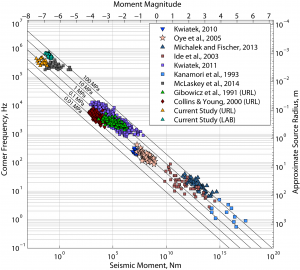
At the largest scale, fractures give rise to volcanoes and earthquakes and at engineering scales they form pathways for fluids to flow through and reduce the strength of rock. For […]
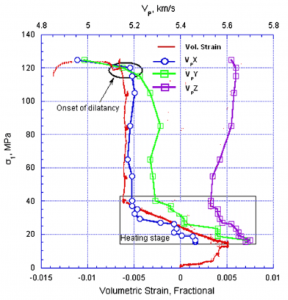
The demand for underground radioactive waste repositories makes the study of thermo-hydro-mechanical (THM) processes in rocks an increasingly important topic. In collaboration with the Nuclear Waste Management Organization (NWMO) we conducted […]
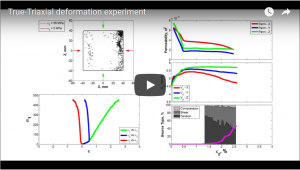
The heart of the Rock Fracture Dynamics Facility is a technologically advanced true-triaxial computer controlled rock deformation system with integral permeability measurement and geophysical imaging capability. For the first time, it is […]
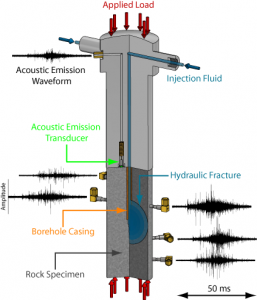
Hydraulic fracturing is the initiation and propagation of a fracture by means of fluid pressurization. Hydraulic fracturing has grown in popularity over the past couple of decades in response to […]
Research Topics
- Rock fracture dynamics: A combination of lab studies and numerical modelling to yield insights into brittle fracture processes
- Induced seismicity: an investigation of relationships between rock damage, rock integrity and seismicity in-situthrough active and passive acoustic studies and advanced data analysis and interpretation techniques
- Earthquake and fault mechanics: Simulation of unstable stick-slip behaviour in the lab and on computers - accompanied by detailed micostructural analyses of fault zones
- Rock damage: understanding the evolution of rock damage under different mechanical, thermal and hydraulic stress conditions using continuous acoustic recording and numerical simulations.
Prospective Research Students
I am not taking on any new graduate students at this time.
Publications
To see the list of publications Please Click Here.