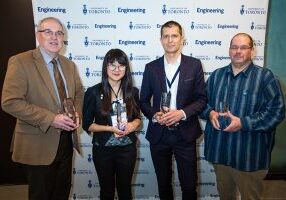

Ron Hofmann
Professor
NSERC Associate Industrial Research Chair
Department of Civil & Mineral Engineering
Email: ron.hofmann@utoronto.ca
Office: GB319C
Tel: 416-946-7508
Drinking Water Treatment Optimization
Background
Professor Ron Hofmann is an NSERC Associate Industrial Chair in Advanced Technologies for Drinking Water Treatment, and is a principal investigator in the Drinking Water Research Group (DWRG). Their DWRG is home to one of the most comprehensive water research laboratories in Canada, providing access to more than $3-million worth of analytical equipment and numerous pieces of experimental equipment for both lab and field use.
The DWRG conducts research with industry partners, governments, and agencies around the world on water-related issues ranging from microbial risk assessment, to photolysis-based advanced oxidation, effectiveness of granular activated carbon, and ferrate treatments. Research completed by the DWRG has had a profound and direct impact on government policies related to the treatment and protection of drinking water. The DWRG is currently working on a variety of advanced water treatment technologies for use in resource-limited and drought-ridden regions.
Publications
| Refereed Journal Articles |
|---|
| Almuhtaram, H., Hofmann, R. (2022) Evaluation of ultraviolet/peracetic acid to degrade M. aeruginosa and Microcystins -LR and -RR. Journal of Hazardous Materials, 424:PartB:127357 https://doi.org/10.1016/j.jhazmat.2021.127357 |
| Kibuye, F.A., Almuhtaram, H., Zamyadi, A., Hofmann, R., Wert, E.C. (2022) Utility practices and perspectives on monitoring and control of cyanobacterial blooms in drinking water sources. AWWA Water Science, 3:6 |
| Zhu, Y., Wang, C., Andrews, S., Hofmann, R., Effect of UV/chlorine oxidation on disinfection byproduct formation from diverse model compounds (2022). Environmental Science & Technology – Water, 2:4:573-582. |
| Almuhtaram, H., Ajjampur, S., Glover, C.M., Kibuye, F., Hofmann, R., Gaget, V., Owen, C., Wert, E.C., Zamyadi, A. (2021) State of knowledge of early warning tools for cyanobacteria detection. Ecological Indicators, 133:108442. |
| Abdalrhman, A.S., Wang, C., Manalac, A., Weersink, M., Abdul-Amir Y., Betz, V., Barbeau, B., Lilge, L., Hofmann, R. (2021) Modelling the efficiency of UV at 254 nm for disinfecting the different layers within N95 respirators. Journal of Biophotonics, 14:10:e202100135. https://doi.org/10.1002/jbio.202100135 |
| Almuhtaram, H., Zamyadi, A., Hofmann, R. (2021) Machine learning and outlier detection in cyanobacterial fluorescence signals. Water Research, 197:1:117073. https://doi.org/10.1016/j.watres.2021.117073 |
| Alonzo-Moya, C., Lake-Thompson, I., Hurtado, A., Hofmann, R. (2021) Evaluation of prechlorination programs for zebra and quagga mussel control in Lake Ontario. Journal of Water Supply: Research and Technology - Aqua, 70:4:537-549. https://doi.org/10.2166/aqua.2021.124 |
| Chen, T., Wang, C., Andrews, S., Hofmann, R. (2021) Effect of UV light path length on UV/chlorine versus UV/H2O2 efficacy. Environmental Science and Technology - Water, 1:5:1145-1152. https://doi.org/10.1021/acsestwater.0c00175 |
| Huang, Y., Schideman, L., Wang, J., Kuo, C., Nie, Z., Hofmann, R. (2021) An experimental method to predict the adsorption of trace organic contaminants in partially-saturated GAC. Environmental Science & Technology – Water, 1:5:1168-1176. https://doi.org/10.1021/acsestwater.0c00244 |
| Yuan, J., Passeport, E., & Hofmann, R. (2021). Understanding Adsorption and Biodegradation in Granular Activated Carbon: A Critical Review. Water Research, 210:118026. |
| Yuan, J., Safari, A., Lugo, P., Alvarez, L., Hofmann, R. (2021) Micropollutant mass transfer zones in granular activated carbon contactors. Environmental Science & Technology – Water, 1:7:1608-1616. https://doi.org/10.1021/acsestwater.1c00092 |
| Pousty, D., Hofmann, R., Gerchman, Y., Mamane, H. (2021) Wavelength-dependent time-dose reciprocity and stress mechanism for UV-LED disinfection of Escherichia coli. Photochemistry and Photobiology B: Biology, 217:112129. https://doi.org/10.1016/j.jphotobiol.2021.112129 |
| Moore, N., Ebrahimi, S., Zhu, Y., Wang, C., Hofmann, R., Andrews, S. (2021) A comparison of sodium sulfite, ammonium chloride, and ascorbic acid for quenching chlorine prior to disinfection byproduct analysis. Water Science and Technology. https://doi.org/10.2166/ws.2021.059 |
| Hurtado, A., Alonzo, C., Hofmann, R. (2021) Effectiveness of peracetic acid and EarthTec QZ for controlling zebra and quagga mussels in drinking water treatment plants on Lake Ontario. Journal of Water Supply: Research and Technology – Aqua. https://doi.org/10.2166/aqua.2020.086 |
| Almuhtaram, H., Wang, C., Hofmann, R. (2021) The Importance of Measuring Ultraviolet Fluence Accurately: A Review of Microcystin-LR Removal by Direct Photolysis (2021). Environmental Science & Engineering Letters. https://dx.doi.org/10.1021/acs.estlett.0c00923 |
| Yuan, J., Huang, Y., Nie, Z., Hofmann, R. (2020) The effect of water temperature on the adsorption of 2-methylisoborneol and geosmin and granular activated carbon. Water Research, 183. https://doi.org/10.1016/j.watres.2020.116065 |
| Lilge, L., Manalac, A., Weersink, M., Schwiegelshohn, F., Young-Schultz, T., Abdalrhman, A.S., Wang, C., Ngan, A., Gu, F.X., Betz, V., Hofmann, R. (2020) Light propagation within N95 filtered face respirators: a simuilation study for UVC decontamination. Journal of Biophotonics, 13:12:2020. https://doi.org/10.1002/jbio.202000232 |
| Wang, C., Zheng, L., Andrews, S., Hofmann, R. (2020) Monochloramine formation and decay in the presence of H2O2 after UV/H2O2 advanced oxidation. Journal of Environmental Engineering, 146:6:06020002. |
| Wang, C., Rosenfeldt, E., Li, Y., Hofmann, R. (2020) External standard calibration method to measure the hydroxyl radical scavenging capacity of water samples. Environmental Science & Technology. 54:3:1929-1937. |
| Nie, Z., Huang, Y., Yuan, J., Murray, A., Woods-Chabane, G., Hofmann, R. (2020) Minicolumn test of remaining GAC performance for taste and odor removal: theoretical analysis. ASCE Journal of Environmental Engineering. 146:1. |
| Wang, C., Hofmann, M., Safari, A., Viole, I., Andrews, S., Hofmann, R. (2019) Chlorine is preferred over bisulfite for H2O2 quenching following UV-AOP drinking water treatment. Water Research. 165:115000 |
| Wang, C., Moore, N., Bircher, K., Andrews, S., Hofmann, R. (2019) Full-scale comparison of UV/H2O2 and UV/Cl2 advanced oxidation: the degradation of micropollutant surrogates and the formation of disinfection byproducts. Water Research. 161:448-458. |
| Lake-Thompson, I., Hofmann, R. (2019) Effectiveness of a copper based molluscicide for controlling dreissena adults. Environmental Science: Water Research & Technology. 5:693-703. |
| Huang, Y., Nie, Z., Murray, A., Li, Y., Yuan, J., Woods-Chabane, G., Hofmann, R. (2019) Experimental validation of a test to estimate the remaining adsorption capacity of granular activated carbon for taste and odour compounds Environmental Science: Water Research and Technology. 5:609-617. DOI: 10.1039/c8ew00600h |
| Almuhtaram, H., Cui, Y., Zamyadi, A., Hofmann, R. (2018) Cyanotoxins and cyanobacteria cell accumulations in drinking water treatment plants with a low risk of bloom formation at the source. Toxins, 10:11:430. |
| Huang, Y., Nie, Z., Wang, C., Li, Y., Xu, M., Hofmann, R. (2018) Quenching H2O2 residuals after UV/H2O2 oxidation using GAC in drinking water treatment. Environmental Science: Water Research & Technology. 4:1662-1670. DOI: 10.1039/C8EW00407B. |
| Huang, Y., Mackenzie, A., Meteer, L., Hofmann, R. (2018) Evaluation of phosphorous removal from a lake by two drinking water treatment plants. Environmental Technology. DOI: 10.1080/09593330.2018.1512656 |
| Fang, T., Hofmann, R., Bolton, J. (2018) The importance of a photon-based approach to quantum yield determinations. Journal of Photochemistry and Photobiology: A. 357:81-84. |
| Fang, T., Andrews, S.A., Hofmann, R. (2017) Comments on a method to measure sucralose using UV photodegradation followed by UV spectrophotometry. Journal of AOAC International. 100:3:810-813. |
| Hofmann, R., Zhang, H., Zamyadi, A., Andrews, S. (2017) The impact of aeration on toxicity from THMs and other DBPs. Journal of the American Water Works Association. 109:10:13-21. |
| Wang, D., Bolton, J.R., Andrews, S.A., Hofmann, R. (2016) Comparison of hydrogen peroxide to ammonium ions and sulfite as a free chlorine quenching agent for disinfection by-product measurement. ASCE Journal of Environmental Engineering. 142:7. |
| Grant, J., Hofmann, R. (2016) A comparative study of the hydroxyl radical scavenging capacity of activated sludge and membrane bioreactor wastewater effluents. Water Science and Technology. 73:6. |
| Loeb, S., Hofmann, R., Kim, J. (2016) Beyond the pipeline: assessing the efficiency limits of advanced technologies for solar water disinfection. Environmental Science and Technology Letters. 3:3. |
| Li, J., Zamyadi, A., Hofmann, R. (2016) Effect of granular activated carbon type and age on quenching H2O2 residuals after UV/H2O2 drinking water treatment. Journal of Water Supply: Research and Technology-Aqua. 65:1. |
| Loeb, S., Andrews, S.A., Hofmann, R. (2015) The effect of immobilized catalyst structure on the degradation of chemical and biological contaminants in simulated solar photocatalytic water purification. Journal of Water Supply: Research and Technology-Aqua. 64:8. |
| Lakghomi, B., Lawryshyn, Y., Hofmann, R. (2015) Evaluation of flow hydrodynamics in a pilot-scale dissolved air flotation tank: a comparison between CFD and experimental measurements. Water Science and Technology: Water Supply. 72:7:1111-1118. |
| Lawryshyn, Y., Hofmann, R. (2015) Theoretical evaluation of UV reactors in series. Journal of Environmental Engineering. 141:10. |
| Zamyadi, A., Sawade, E., Ho, L., Newcombe, G., Hofmann, R. (2015) The impact of UV-H2O2 advanced oxidation and ageing process on GAC capacity for removal of cyanobacterial taste and odour compounds. Environmental Health Insights. 9:Suppl. 3, 1-10. |
| Wang, D., Bolton, J.R., Andrews, S.A.A., Hofmann, R. (2015) UV/chlorine control of drinking water taste and odour at pilot and full-scale. Chemosphere. 136:239-244. |
| Zhou, E., Payne, S.J., Hofmann, R., Andrews, R.C. (2015) Factors affecting lead release in sodium silicate-treated partial lead service line replacement. Journal of Environmental Science and Health, Part A. 50:9:922-930. |
| Zamyadi, A., Henderson, R., Stuetz, R., Hofmann, R., Ho, L., Newcombe, G. (2015) Fate of geosmin and 2-methylisoborneol in full-scale water treatment plants. Water Research. 83:171-183. |
| Lakghomi, B., Lawryshyn, Y., Hofmann, R. (2015) A model of particle removal in a dissolved air flotation tank: importance of stratified flow and bubble size. Water Research. 68:1:262-272. |
| Wang, D., Bolton, J.R., Andrews, S.A.A., Hofmann, R. (2015) Formation of disinfection by-products in the ultraviolet/chlorine advanced oxidation process. Science of the Total Environment, 518-519:49-57. |
| Zhang, J. and Hofmann, R. (2013) Modeling the Adsorption of Emerging Contaminants on Activated Carbon: Classical and Quantum QSAR Approaches. Water Science and Technology: Water Supply, 13:6:1543-155. |
| Wu, S.K., Smith, K., Hofmann, R., and R.E. Cantwell. (2013) Factors influencing nitrification in point of use BioSand Filters. Journal of Water Supply: Research and Technology-Aqua, 62:6:359-366. |
| Smith, K., Zhang, X. and Hofmann, R. (2012) Assessment of alternative characterization tests for prediction of taste and odour control by granular activated carbon. Water Science and Technology: Water Supply, 12:4:531‐539. |
| Wang, D., Bolton, J. and Hofmann, R. (2012) The UV/Chlorine advanced oxidation process for the destruction of trichloroethylene in drinking water. Water Research, 46:15:4677‐4686. |
| Lakghomi, B., Lawryshyn, Y. and Hofmann, R. (2012) Importance of flow stratification and bubble‐bubble interaction in the separation zone of dissolved air flotation. Water Research, 46:14:4468‐4476. |
| Simhon, M.V., Minnery, J.G., Hofmann, R. (2012) Adenovirus control in small drinking water systems: risks and strategies. Journal of Water Technology: Research and Supply—Aqua, 61:2:94‐102. |
| Watts, M.J., Hofmann, R., and Rosenfeldt, E.J. (2012) Low‐pressure UV/Cl2 for advanced oxidation of taste and odor. Journal of the American Water Works Association, 104:1:47‐48. |
| Hofmann, R., Amiri, F., Wilson, S., Garvey, E., Metcalfe, C., Ishida, C., and Lin, K. (2011) Comparing methods to remove emerging contaminants and disinfection by‐product precursors at pilot scale. Journal of Water Technology: Research and Supply—Aqua, 60:7:425‐433. |
| Cantwell, R., and Hofmann, R. (2011) Errors in UV Fluence Calculations due to Particles in Wastewater Samples. Environmental Engineering Science, 28:2:159‐162. |
| Cantwell, R., and Hofmann, R. (2011) Ultraviolet Absorption Properties of Suspended Particulate Matter in Untreated Surface Water.Water Research, 45:3:1322‐1328. |
| Cantwell, R., Hofmann, R., Rand, J., Devine, P. and VanderMarck, M. (2010) Case Study of Particle‐Related UV Shielding of Microorganisms when Disinfecting Unfiltered Surface Water. Water Quality Research Journal of Canada, 45:3:343‐351. |
| Wojcicka, L., Baxter, C. and Hofmann, R. (2009) Impact of Particulate Matter on Distribution System Disinfection Efficacy. Water Quality Research Journal of Canada, 43:1:55‐62. |
| Templeton, M., Cantwell, R., Quinn, C., Hofmann, R., and Andrews, R.C. (2009) Pilot‐Scale Assessment of the Impacts of Transient Particulate Water Quality Events on the UV Disinfection of Indigenous Total Coliform Bacteria in Drinking Water. Journal of Water Supply: Research and Technology – Aqua, 58:1:11‐20. |
| Templeton, M.R., Andrews, R.C., and Hofmann, R. (2008) Particle‐Associated Viruses in Water: Impact on Disinfection Processes. Critical Reviews in Environmental Science and Technology, 38:3:137‐164. |
| Cantwell, R., Hofmann, R., and Templeton, M. (2008) Interactions Between Humic Matter and Bacteria when Disinfecting Water with UV Light. Journal of Applied Microbiology, 105:1:25‐35. |
| Cantwell, R., and Hofmann, R. (2008) Inactivation of Indigenous Coliform Bacteria in Unfiltered Surface Water by Ultraviolet Light. Water Research, 42:10‐11:2729‐2735. |
| Alam, M.Z.B., Cantwell, R., Hofmann, R., Andrews, R.C., Rand, J., Gagnon, G. and VanderMarck, M. (2008) Effect of ClO2 Preoxidation on Subsequent Water Treatment Processes. ASCE Journal of Environmental Engineering, 134:6:478‐485. |
| Betanzo, E., Hofmann, R., Hu, Z., Baribeau, H. and Alam, M.Z.B. (2008). Modeling the Impact of Microbial Intrusion on Secondary Disinfection in a Drinking Water Distribution System. ASCE Journal of Environmental Engineering, 134:4:231‐237. |
| Hofmann, R. and Andrews, R.C. (2007) Potential Side Effects of Using Ammonia to Inhibit Bromate Formation During the Ozonation of Drinking Water. Journal of Environmental Engineering and Science, 6:6:739‐743. |
| Templeton, M.R., Andrews, R.C., and Hofmann, R. (2007) Reduction of Particle‐Associated Bacteriophages by Dual‐Media Filtration and UV Disinfection. Water Research, 41:11:2393‐2406. |
| Rand, J., Hofmann, R., Alam, Z.B., Chauret, C., Cantwell, R., Andrews, R., and Gagnon, G. (2007) A Field Study Evaluation for Mitigating Biofouling with Chlorine Dioxide or Chlorine Integrated with UV. Water Research, 41:9:1939‐1948. |
| Wojcicka, L., Hofmann, R., Baxter, C., Auvray, I., Liere, J., Miller, T., Baribeau, H., Andrews, R.C. and Chauret, C. (2007) Inactivation of Environmental and Reference Strains of Heterotrophic Bacteria and Escherichia coli O157:H7 by Free Chlorine and Monochloramine.Journal of Water Supply: Research and Technology (Aqua), 56:2:137‐150. |
| Templeton, M.R., Andrews, R.C., and Hofmann, R.<.strong> (2006) Case Study Comparisons of Computational Fluid Dynamics (CFD) Modeling versus Tracer Testing for Determining Clearwell Residence Times in Drinking Water Treatment. Journal of Environmental Engineering and Science, 5:6:529‐536. |
| Baxter, C., Hofmann, R., Templeton, M.R., Brown, M. and R.C. Andrews (2006) Inactivation of Adenovirus Types 2, 5, and 41 in Drinking Water by UV Light, Free Chlorine, and Monochloramine. ASCE Journal of Environmental Engineering, 133:1:95‐103. |
| Hofmann, R. and R.C. Andrews (2006) Impact of H2O2 and (Bi)carbonate Alkalinity on Ammonia's Inhibition of Bromate Formation. Water Research, 40:18:3343‐3348. |
| Templeton, M.R., Hofmann, R., and R.C. Andrews (2006) UV Inactivation of Humic‐coated Bacteriophages MS2 and T4 in Water. Journal of Environmental Engineering and Science, 5:6:537‐543. |
| Templeton, M.R., Andrews, R.C., and Hofmann, R. (2006) Impact of Iron Particles in Groundwater on the UV Inactivation of Bacteriophages MS2 and T4. Journal of Applied Microbiology, 101:3:732‐741. |
| Templeton, M.R., Hofmann, R., Andrews, R.C., and G.E. Whitby (2006) Biodosimetry Testing of a Simplified Computational Model for the UV Disinfection of Wastewater. Journal of Environmental Engineering and Science, 5:1:29‐36. |
| Templeton, M.R., Andrews, R.C., and Hofmann, R. (2005) Inactivation of particle‐associated viral surrogates by ultraviolet light. Water Research, 39:15:3487‐3500. |
| Hofmann, R., Andrews, R.C., and P. Lachmaniuk (2004) Guidelines for Ultraviolet Disinfection of Drinking Water: Considerations for Ontario. Journal of Toxicology and Environmental Health, 67:20‐22:1805‐1812. |
| Hofmann, R., Andrews, R.C., and G. Ranger (2003) Water Quality and Disinfection Impact of ClO2 Contamination by Free Chlorine: A Case Study. Journal of Environmental Engineering and Science, 3:2:75‐80. |
| Verhille, S., Hofmann, R., Chauret, C. and R.C. Andrews (2003) Indigenous Bacterial Spores as Indicators of Cryptosporidium Inactivation Using Chlorine Dioxide. Journal of Water and Health, 1:2:91‐100. |
| Hofmann, R., Larcher, S. and R. Andrews (2002) Effect of Several Natural Water Constituents on Bromate Formation During Ozonation.Water Science and Technology: Water Supply, 2:5‐6:501‐507. |
| Volk, C.J., Hofmann, R., Chauret, C., Gagnon, G.A., Ranger, G., and R.C. Andrews (2002) Implementation of Chlorine Dioxide Disinfection: Effects of the Treatment Change on Drinking Water Quality in a Full‐Scale Distribution System. Journal of Environmental Engineering and Science, 1:323‐330. |
| Hofmann, R. and R.C. Andrews (2001) Ammoniacal Bromamines: A Review of Their Influence on Bromate Formation During Ozonation.Water Research, 35:3:599‐604. |
| Hofmann, R., Andrews, R.C. and Q. Ye (1999) Impact of Giardia Inactivation Requirements on ClO2 By‐Products. Environmental Technology, 20:147‐158. |
| Hofmann, R., Andrews, R.C. and Q. Ye (1998) Comparison of Spectrophotometric Methods for Measuring Chlorine Dioxide in Drinking Water. Environmental Technology, 19:761‐773. |
| Bagley, D.M. and Hofmann, R. (1998) Discussion: Environmental Impacts of Nutrient Removal Processes: Case Study. ASCE Journal of Environmental Engineering, 124:5:481. |